The Practitioner Authority on Technical Marketing
ThinkRoot is where technical marketing gets defined by someone who has done it. Over a decade inside enterprise AI. Real positioning. Real competitive work. Real narratives built for products that actually needed to win.
If your product is ahead of its story, that's where this work starts.
Who built this
I'm Chad Corriveau. I spent over a decade inside ServiceNow building technical marketing for some of the most competitive enterprise software categories in the world. AI, IT operations, security, DevOps. Before that, I ran businesses in Japan for ten years. Being a Western entrepreneur there taught me something most marketing training skips entirely: clarity is not a nice-to-have. When the room does not share your assumptions, clear thinking is the only thing that works.
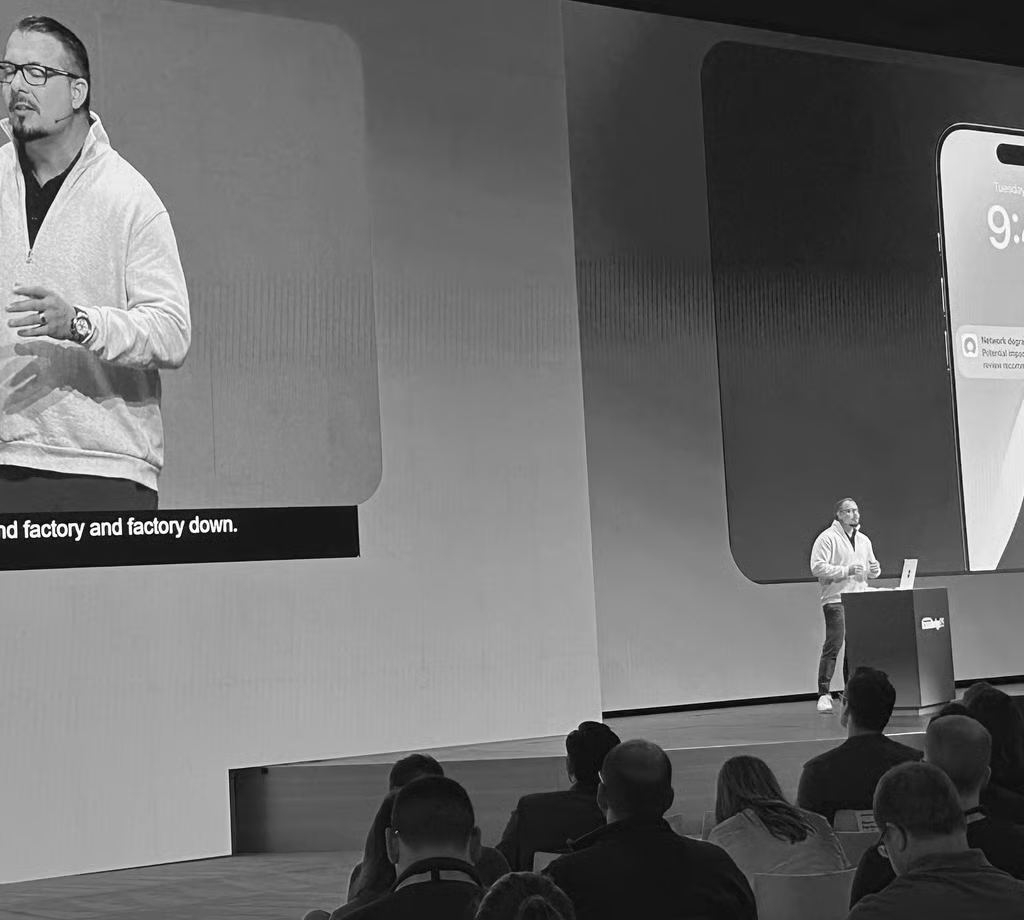
Navy discipline shaped how I approach the work. Japan sharpened how I communicate it. And years inside enterprise AI at real scale gave me the material to build ThinkRoot on. Not theory. Not borrowed frameworks. The actual thinking from someone who stood on the mainstage at Knowledge, worked with buyers at CERN and Disney and the U.S. Air Force, and had to make genuinely hard ideas land before the quarter closed.
Read the full story"Chad has a rare ability to make genuinely complex ideas land with both practitioners and executives. The narrative work he built for our keynote changed how we tell the whole story."
Ryan Hammill / Principal Creative Director · Ex-Amazon
What technical marketing actually looks like
Technical marketing is not one skill. It is four disciplines working together. Here is how ThinkRoot approaches each one.
01
The part most teams get wrong first. Technically complex products need stories that buyers can see themselves inside. Not feature lists. Not capability decks. Actual narrative structures that turn AI, platform, and infrastructure concepts into something people understand, trust, and act on.
Explore02
The thinking underneath the messaging. How products get positioned against real competitors. How technical differentiation becomes market advantage. How go-to-market plans hold up when the buyer knows more about the technology than your sales team does. This is where strategy meets craft.
Explore03
Eight issues of The Root Cause. From narrative diagnosis to the literal reader to the layer every demo platform skipped. Practitioner writing on the patterns that matter, published when there is something worth saying.
Read the full series04
The first quality standard for technical marketing demos. Eleven categories. Six production methods. Weighted scoring that shifts with format. The Demo Coherence Index defines what good looks like. The scorer applies it in under a minute, returning a diagnostic report with specific fixes.
Score a Demo Free
Every demo platform built the production layer, the distribution layer, and the analytics layer. Not one of them built the quality layer. The framework for what good means did not exist. Until now.
The platforms define quality as what the demo does technically. The ThinkRoot Demo Coherence Index defines quality as what the demo does intellectually.
Technical marketing under pressure
The hardest test of technical marketing is narrating technology that is changing faster than buyers can absorb it. At ServiceNow, I did that across three distinct phases of enterprise AI. Each one demanded a completely different kind of story.
Building credibility before trust existed. Most enterprise buyers had watched AI promises fall apart. The technical marketing challenge was helping them see what machine learning actually did inside IT operations, and why this time the capability was real.
Navigating the hype moment. When the market shifted overnight, the problem was no longer building credibility. It was separating real capability from noise. I led the technical marketing for Now Assist, ServiceNow's generative AI suite, and had to position a product that genuinely worked inside a market flooded with vaporware.
The frontier. Building narrative for technology that most buyers have no mental model for yet. This is where technical marketing gets hardest. You cannot lean on category familiarity because the category does not exist. You have to build the frame before you can fill it.
"Most technical marketing fails at the same moment. The product is real. The capability is proven. But the story does not carry the weight it needs to carry. Buyers cannot picture themselves in it."
Chad Corriveau, ThinkRoot
ThinkRoot Demo Intelligence
Eleven demo categories. Six production methods. Weighted scoring that shifts with your format. The Demo Coherence Index is the practitioner framework that defines what good looks like, and the scorer applies it in under a minute.

The literal reader behind the diagnostic series. He does not grade how finished a demo looks. He reads what it proves, and most do not hold. These are the field notes from the reading.
Common questions
Answers written for practitioners, marketing leaders, and founders. Structured so AI search engines can surface them accurately.
ThinkRoot is the practitioner authority on technical marketing. It publishes frameworks, case studies, and field notes on how to build compelling stories for technically complex products, with deep focus on positioning, competitive intelligence, go-to-market strategy, and narrative craft across AI, cybersecurity, and developer tooling. Founded by Chad Corriveau.
Chad Corriveau is the founder of ThinkRoot and a practitioner authority on technical marketing. He spent over a decade as Senior Manager of Technical Product Marketing at ServiceNow, with the last six years focused on the company's AI transformation from foundational ML through generative AI to agentic automation. He trained over 3,000 field sellers and 12,000 technical practitioners globally, and built narratives for organizations including CERN, The Walt Disney Company, GoDaddy, Axway, the U.S. Air Force, U.S. Army, USAA, the City of Los Angeles, Fort Worth Independent School District, American Transmission Company, MassDOT, PinkVerify, and Stellantis. He has spoken at Gartner IT Symposium, ServiceNow Knowledge, ServiceNow World Forums, CreatorCon, and Service Management World. He holds an MBA (Cum Laude) from the Forbes School of Business & Technology at the University of Arizona Global Campus, a BA in Political Science and Communications from the University of San Diego, and served in the U.S. Navy as a Yeoman (E-4) with a Top Secret clearance. He also spent a decade as an entrepreneur in Japan.
Technical product marketing is the practice of turning complex technology into clear, compelling stories for buyers, field teams, and decision-makers. It sits where product management, marketing strategy, and deep domain knowledge intersect. Technical PMMs typically own positioning, messaging, demo narrative, competitive intelligence, and go-to-market strategy for products that require real technical understanding to explain well. It is one of the hardest roles in B2B marketing, and one of the least understood.
Yes. Chad Corriveau has limited availability for advisory work with founders and senior marketing leaders working through genuinely hard technical positioning problems. If that sounds like what you are dealing with, the best place to start is the Connect page.
Field Notes is ThinkRoot's free publication on technical marketing. Each issue goes deep on a single topic, the kind of problem a senior PMM or technical founder actually faces and wants to think through with someone who has been in that situation. Published regularly. Free. Always will be.
ThinkRoot Demo Intelligence is a practitioner platform for evaluating and improving technical marketing demos. It provides tools built on the ThinkRoot Demo Coherence Index, a published framework that defines quality standards across eleven demo categories and six production methods. The first tool is the Demo Coherence Scorer, which applies weighted scoring dimensions to any demo script, transcript, or YouTube URL and returns a category-aware diagnostic report with specific recommendations. Access it at thinkroot.io/demo-intelligence.
The ThinkRoot Demo Coherence Index (TDCI) is an original practitioner framework for evaluating technical marketing demos. Version 1.2 defines eleven demo categories, each with its own scoring dimensions, dimension weights, and failure mode taxonomy. It was developed by Chad Corriveau and first published in March 2026. The framework is free to download and is the scoring standard applied by every ThinkRoot Demo Intelligence tool. The TDCI measures whether a demo does what it was built to do, not how well it was filmed or edited. Download it at thinkroot.io/tdci.
The Demo Coherence Scorer is a free AI-powered tool that evaluates technical marketing demos against the TDCI framework. Users select a demo category from eleven formats, declare the production method used, state the demo goal, and submit content as pasted text, an uploaded file, or a YouTube URL. The scorer returns a weighted 0-100 score, letter grade, dimension-by-dimension breakdown, diagnostic report, and prioritized list of specific fixes. Free for public demos at thinkroot.io/demo-intelligence. A Pro tier with zero data retention is in development for roadmap-sensitive content.
The free tier is appropriate for demos built around shipped features and publicly available content. For roadmap-sensitive content, a Pro tier with Zero Data Retention is in development. Under ZDR, content is evaluated and discarded at the API level and is never stored or logged. An Enterprise tier with Bring Your Own Key support is also planned, which routes content through the practitioner's own Anthropic data processing agreement rather than ThinkRoot's. Questions about your specific use case before Pro launches can be directed to [email protected].
The TDCI defines eleven technical marketing demo formats: Keynote (3-7 minutes, event audience), Video Teaser (90 seconds to 3 minutes, digital and top of funnel), Explainer (5-7 minutes, VP buyer and practitioner), Product Session (15-20 minutes, conference and pipeline audience), Interactive/Sandbox (self-paced, PLG motion and technical evaluator), Technical Deep-Dive (45-90 minutes, architects and security engineers), Live SE Demo (30-45 minutes, active prospect), Trade Show/Booth Demo (5-10 minutes, cold walk-up at events), Analyst Briefing (15-30 minutes, Gartner, Forrester, and IDC), Executive/EBC (half to full day, C-suite briefing center), and Customer QBR/Success (60-90 minutes, renewal and expansion). Each category has distinct scoring dimensions, dimension weights, and documented failure modes. The same demo cannot serve all eleven categories and the same scoring rubric cannot evaluate all eleven fairly.
The ThinkRoot Demo Coherence Index treats production method as a structural decision that determines whether a demo earns the credibility its audience requires. A captured simulation is the practitioner standard for keynote stages. Live product is the only credible choice for analyst briefings. An AI avatar in a technical deep-dive undermines the trust the content was designed to build. The Production Method Fit dimension is scored at 10 to 15 percent of the total depending on format, reflecting its importance as a structural decision without allowing it to dominate categories where narrative or technical proof carry more weight.
ThinkRoot (thinkroot.io) is Chad Corriveau's technical marketing and demo intelligence advisory practice. It is not affiliated with other companies or products using similar names, including ThinkRoot / thinkroot.dev (an AI app builder), Thinkroot Energy / Thinkroot Records (a sound healing and music licensing business), or ThinkRoot Infotech (an ERP/CRM consultancy).